
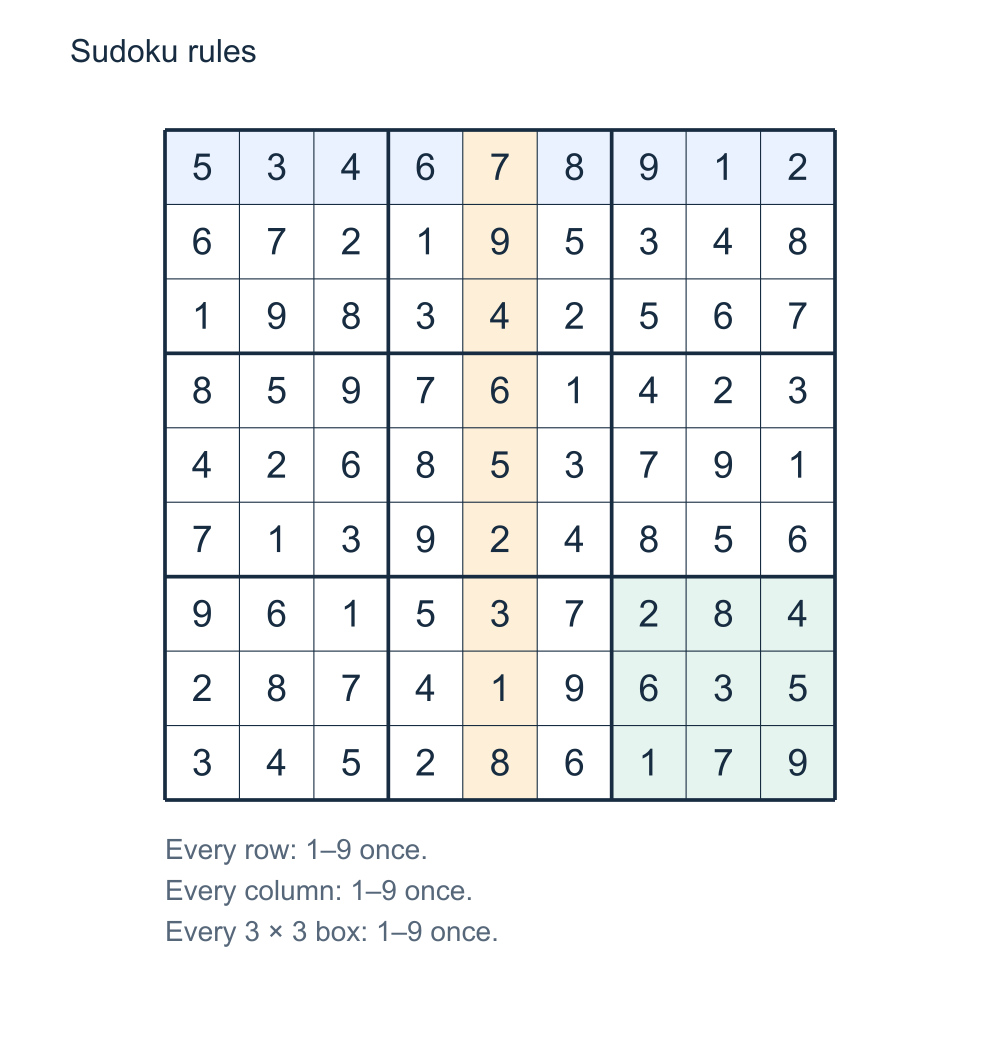
Sudoku rules illustrated
A completed grid highlights a row, a column and a 3×3 box to show the three standard Sudoku constraints.
Sudoku is a logic-based number puzzle played on a 9x9 grid. The rules are simple to understand but lead to endlessly varied challenges. No math is required, just careful reasoning and pattern recognition.
The objective of Sudoku is to fill every empty cell in the grid with a digit from 1 to 9 so that each digit appears exactly once in every row, every column, and every 3x3 box. A puzzle starts with some cells already filled in. These given numbers are your clues, and they cannot be changed. Your job is to deduce the remaining numbers using logic alone.
These three constraints are all you need to know. Every Sudoku-solving technique, from the simplest to the most advanced, is built on the logical consequences of these rules.
A standard Sudoku grid is 9 cells wide and 9 cells tall, giving you 81 cells in total. The grid is divided into nine 3x3 boxes separated by thicker lines. Understanding the structure is essential for applying the constraints correctly.
A single row (highlighted)
A single column (highlighted)
A 3x3 box (highlighted)
The grid contains 9 rows (running left to right), 9 columns (running top to bottom), and 9 boxes (the 3x3 sub-grids). Each of these 27 units must contain every digit from 1 to 9 exactly once. Every cell belongs to exactly one row, one column, and one box.
Despite involving the digits 1 through 9, Sudoku is not a math puzzle. The numbers do not need to add up to anything. They are simply nine distinct symbols. You could replace them with letters, colors, or shapes and the puzzle would work the same way. The only thing that matters is that each symbol appears exactly once in every row, column, and box.
When a puzzle begins, some cells are already filled with numbers. These are called givens or clues. A well-constructed Sudoku puzzle has exactly one valid solution, meaning there is only one way to fill in all the remaining cells without breaking any of the three constraints.
The number of givens varies by difficulty. Easy puzzles may start with 36 to 45 given numbers, while the hardest puzzles can have as few as 17 givens, which is the mathematical minimum for a unique solution.
You solve a Sudoku puzzle when every one of the 81 cells contains a digit and all three constraints are satisfied simultaneously. That means every row has 1 through 9, every column has 1 through 9, and every 3x3 box has 1 through 9.
There is no guessing required in a proper Sudoku puzzle. Every cell can be determined through logical deduction. If you ever find yourself needing to guess, it usually means you have missed a deduction somewhere. As you learn more techniques, you will be able to solve harder puzzles without ever resorting to trial and error.
A completed grid highlights a row, a column and a 3×3 box to show the three standard Sudoku constraints.
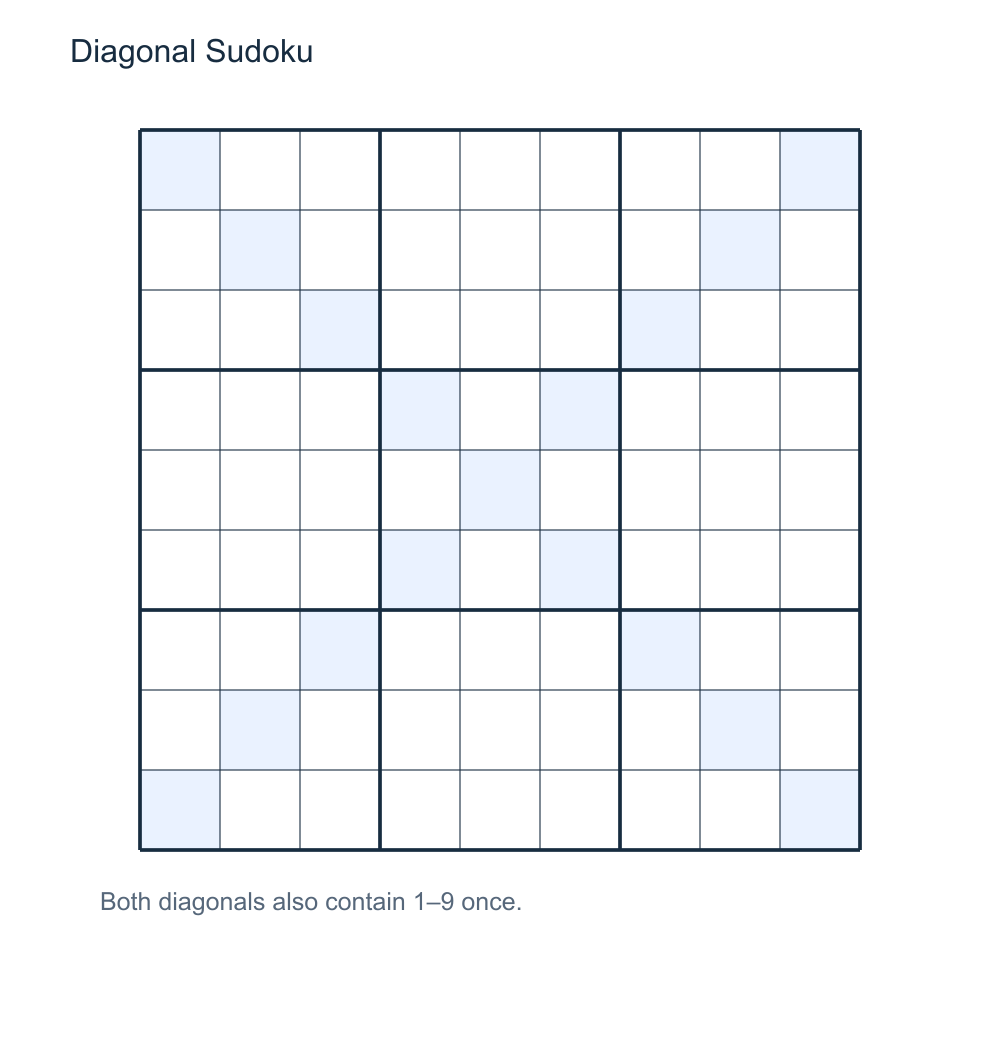
A Sudoku X grid highlights both main diagonals to explain the additional rule used in diagonal Sudoku.