
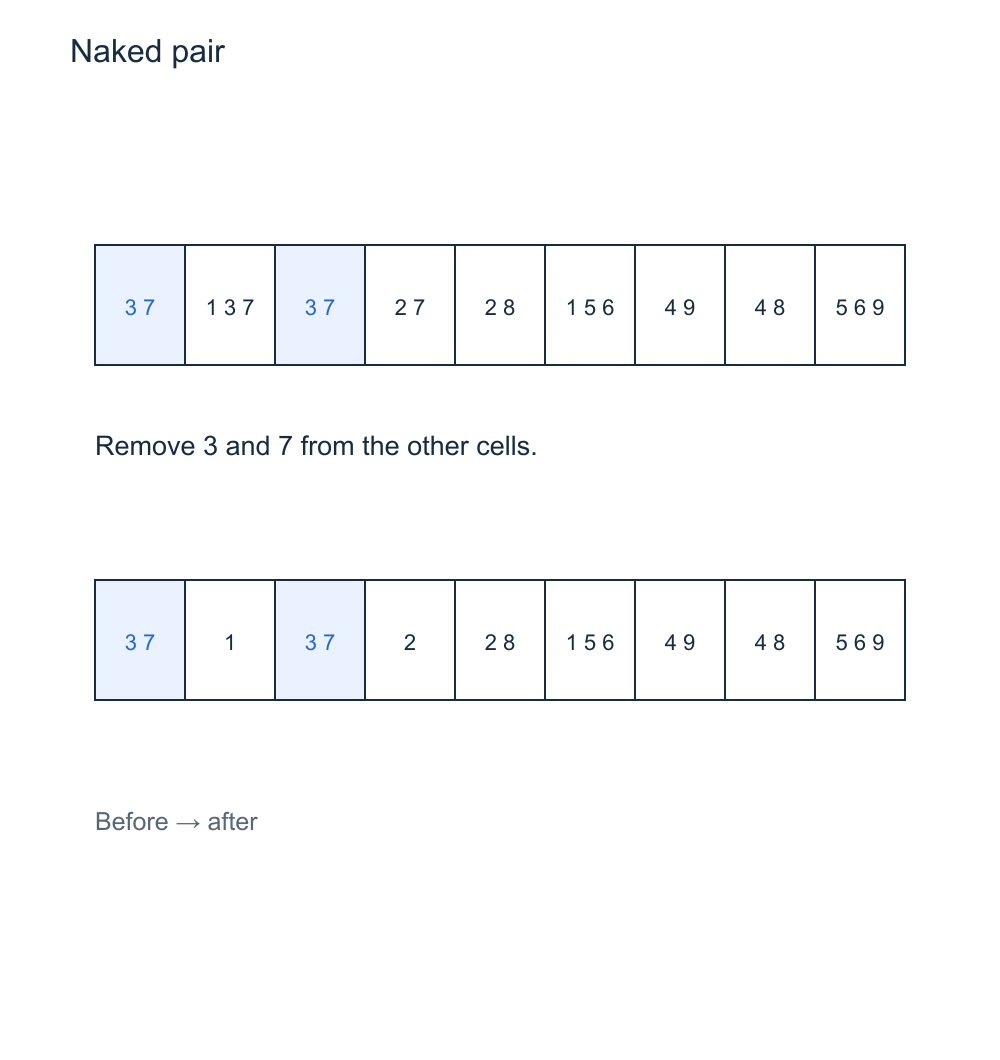
Naked pair Sudoku: before and after
A row-level diagram shows two cells containing only 3 and 7, followed by the candidate eliminations they allow.
Naked Pairs is one of the most fundamental intermediate Sudoku techniques and often the first subset strategy that solvers learn after mastering basic elimination and hidden singles. A Naked Pair occurs when two cells in the same row, column, or box each contain exactly the same two candidates and no other candidates. Because those two digits must occupy those two cells in some order, they can be safely eliminated from all other cells in the shared unit.
For example, if two cells in a row both contain only candidates {3, 7}, then 3 and 7 are locked into those two cells. No other cell in that row can contain 3 or 7, so you can remove those digits from the candidate lists of every other cell in the row. This often reveals hidden singles or triggers further eliminations that cascade through the puzzle.
Naked Pairs appear frequently in medium-difficulty puzzles and are essential for progressing beyond basic techniques. Learning to spot them quickly trains your eye for the more advanced subset patterns like Naked Triples and Naked Quads. The key habit to develop is scanning each unit for cells with small candidate lists and checking whether any two share the exact same pair of candidates.
Walk through each step of the naked pairs technique on a real puzzle. Follow the instructions and try entering the correct value when prompted.
Look at row 8 (index 7). Several cells are empty. Start by identifying which cells have only two candidates remaining. Focus on the empty cells in this row.
A row-level diagram shows two cells containing only 3 and 7, followed by the candidate eliminations they allow.
Update all pencilmarks so every cell has an accurate list of remaining candidates.
Scan a row, column, or box for cells that contain exactly two candidates.
Check whether any two of these bivalue cells share the exact same two candidates.
If a Naked Pair is found, note the two digits and the unit they share.
Eliminate those two digits from all other cells in the same row, column, or box.
Check whether the eliminations reveal any naked singles or hidden singles.
Repeat the scan for other units across the grid.
Think of two roommates who only eat pizza or tacos. Since those two meals are spoken for, nobody else in the house can have pizza or tacos for dinner.
A Sudoku unit must contain each digit exactly once. If two cells in a unit can only hold digits A and B, then by the pigeonhole principle those two cells must consume both A and B, leaving zero copies of either digit for the remaining cells. Any occurrence of A or B elsewhere in that unit would make it impossible to fill both constrained cells, violating the uniqueness constraint.
When to use: Use Naked Pairs when you spot two cells in the same row, column, or box that each contain exactly the same two candidates and nothing else. This is often the first technique to try after basic singles stop working.
Confusing Naked Pairs with Hidden Pairs -- the cells in a Naked Pair must contain ONLY the two pair digits, with no extra candidates.
Double-check that both cells have exactly two candidates and they are the same two digits. If cells have additional candidates, look for a Hidden Pair instead.
Forgetting to eliminate the pair digits from all shared units. If the two cells share both a row and a box, you must eliminate from both.
After finding a Naked Pair, check every unit (row, column, and box) that both cells belong to and remove the pair digits from all other cells in each shared unit.
Trying to apply Naked Pairs with outdated pencilmarks, leading to incorrect eliminations.
Always update all pencilmarks before scanning for Naked Pairs. A missing or extra candidate can cause you to miss the pattern or make a false identification.
See naked pairs applied in different puzzle configurations to strengthen your pattern recognition.
Row Naked Pair
Highlighted cells show the naked pairs pattern
Apply the naked pairs technique on these mini challenges. Tap a highlighted cell and enter the correct digit.