
Blank Sudoku grid with pencil-mark guides
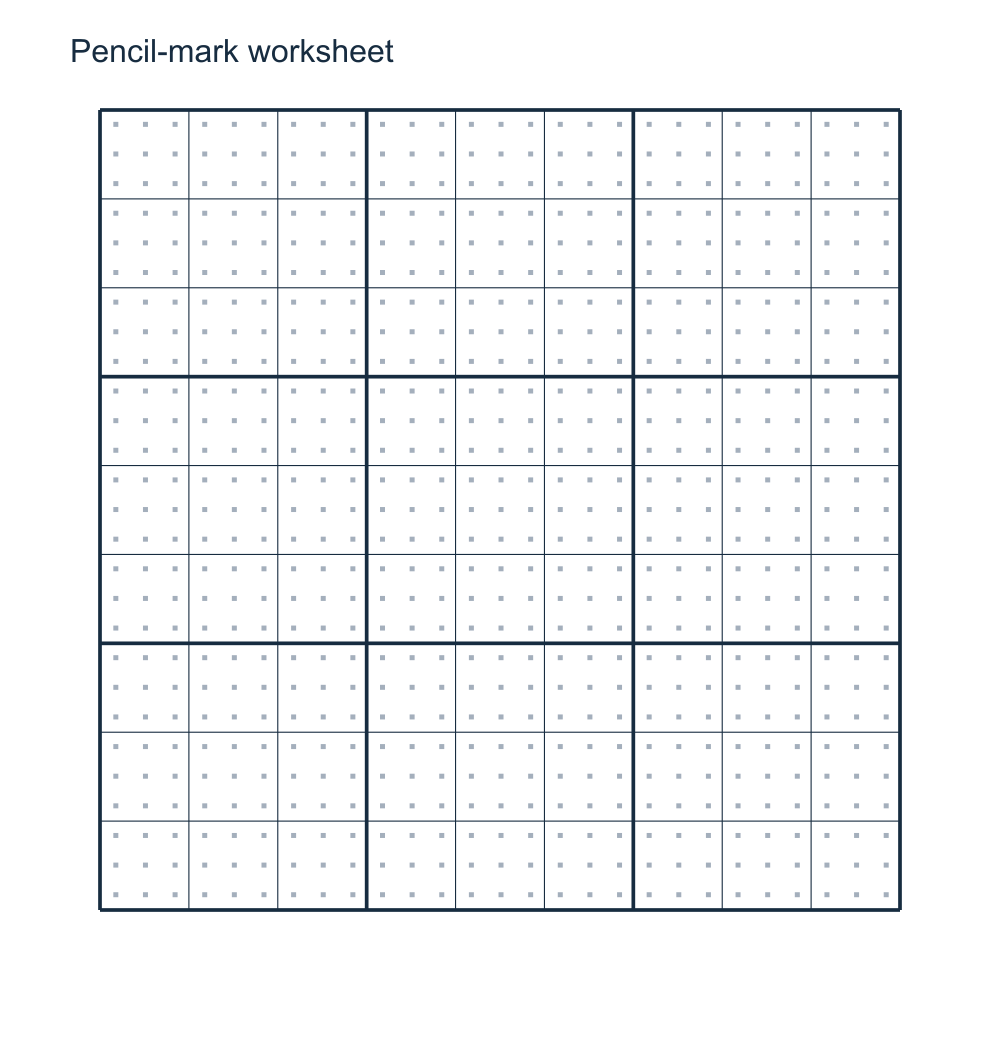
An empty 9×9 template with nine subtle guide dots in each cell, leaving space to record possible digits.
Pencil Marking is the essential practice of writing small candidate numbers in empty cells to track which digits are still possible in each position. While not a solving technique in itself, pencil marking is the foundation that makes all intermediate and advanced techniques possible. By maintaining an accurate set of candidates for every empty cell, you can spot patterns and eliminations that are invisible to the naked eye.
To pencil mark a cell, examine its row, column, and 3x3 box. Write down every digit from 1 to 9 that does not already appear in any of these three units. These are the cell's candidates. As you solve the puzzle and place more digits, update the pencil marks by removing newly eliminated candidates from all cells that share a row, column, or box with the placed digit. Keeping pencil marks current is critical for accuracy.
Many beginners resist pencil marking because it seems tedious, but it is a skill that separates casual solvers from proficient ones. With practice, you will learn to pencil mark efficiently — focusing on cells with fewer candidates first, and only marking cells in areas where you are actively working. Pencil marking reveals Naked Singles that you might otherwise miss and sets up the candidate patterns needed for techniques like Naked Pairs, Pointing Pairs, and beyond. Start building this habit early, and every subsequent technique will become easier to apply.
Walk through each step of the pencil marking technique on a real puzzle. Follow the instructions and try entering the correct value when prompted.
Let us pencil mark cell (0,0). First, check row 0: it contains 3, 1, 2, 6, 7, 8. Check column 0: it contains 6, 9, 1, 2, 7, 8, 5, 3. Check the top-left box: it contains 3, 1, 2, 6, 5, 4, 9, 8, 2, 7.
An empty 9×9 template with nine subtle guide dots in each cell, leaving space to record possible digits.
Start with an empty cell you want to analyze.
Check the cell's row and note which digits from 1-9 are already present.
Check the cell's column and note which additional digits are present.
Check the cell's 3x3 box and note any further digits present.
The remaining digits that are NOT in any of these three units are the cell's candidates — write them small in the cell.
Repeat for all empty cells, or focus on a specific region you are solving.
When you place a new digit, immediately update pencil marks by removing that digit from all cells in the same row, column, and box.
Think of pencil marks as a shortlist of job applicants for each open position. You write down everyone who qualifies, and as you hire people elsewhere, you cross names off the lists until only one candidate remains.
Pencil marking is a concrete representation of the constraint-satisfaction problem at each cell. By recording every digit not yet excluded by the cell's row, column, and box, you maintain a complete and sound picture of the remaining solution space. This exhaustive tracking ensures no valid candidate is overlooked and makes elimination patterns — the basis of every advanced technique — visible and verifiable rather than reliant on mental recall.
When to use: Start pencil marking whenever simple scanning techniques stop producing placements. Focus on regions where you are actively working rather than marking the entire grid at once.
Pencil marking the entire grid at the start and then forgetting to update marks when new digits are placed.
Every time you place a digit, immediately erase that digit from the pencil marks of all cells in the same row, column, and box.
Accidentally omitting a valid candidate because you miscounted the digits in a row, column, or box.
Systematically go through digits 1-9 for each cell rather than eyeballing it. Check all three units before finalizing the candidate list.
Writing pencil marks so large or messily that they become hard to read and lead to errors later.
Use small, consistent notation — place each candidate digit in a fixed position within the cell so you can read them at a glance.
See pencil marking applied in different puzzle configurations to strengthen your pattern recognition.
Highlighted cells show the pencil marking pattern
Apply the pencil marking technique on these mini challenges. Tap a highlighted cell and enter the correct digit.