
X-Wing Sudoku diagram
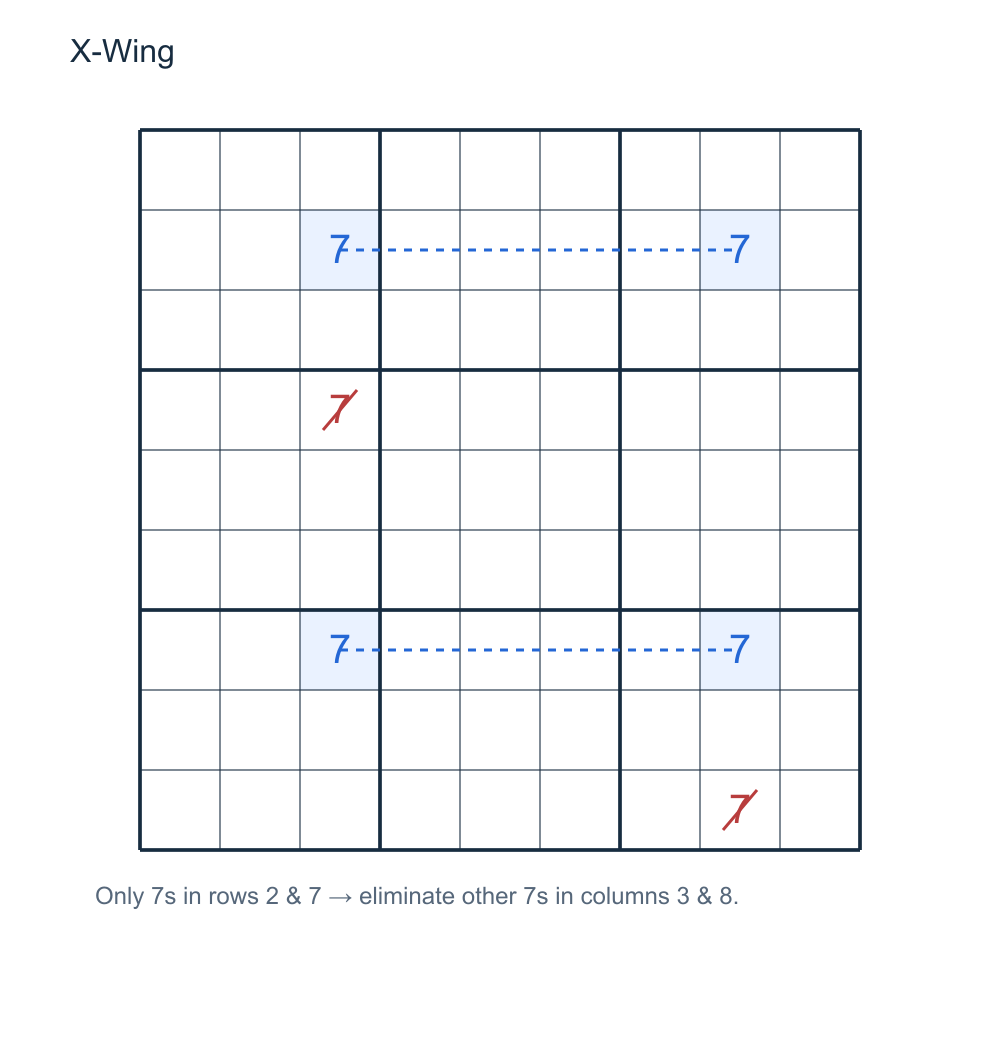
A candidate diagram shows the four corners of an X-Wing and the sevens it eliminates in the shared columns.
The X-Wing is one of the most well-known advanced Sudoku techniques. It occurs when a particular candidate digit appears in exactly two cells in each of two different rows, and those cells are aligned in the same two columns. Because the candidate must appear once in each row, it must occupy one of the two possible column positions in each row. This creates a rectangle of four cells where the candidate locks into a diagonal pattern — either top-left and bottom-right, or top-right and bottom-left.
Since the candidate is guaranteed to fill two of the four corners in this diagonal arrangement, it cannot appear in any other cell within those two columns. Therefore, you can safely eliminate that candidate from all other cells in the two columns that are outside the X-Wing rows. The same logic applies when the pattern is found in columns instead of rows — in that case, eliminations occur across the two rows.
The X-Wing is the simplest member of the "fish" family of techniques, which also includes Swordfish (3x3) and Jellyfish (4x4). Mastering the X-Wing teaches you the fundamental principle of set-based candidate elimination and trains your eye to scan for aligned candidate positions across the grid. It is a critical tool for solving hard-rated Sudoku puzzles where basic and intermediate techniques are insufficient.
Walk through each step of the x-wing technique on a real puzzle. Follow the instructions and try entering the correct value when prompted.
We are looking for an X-Wing pattern on candidate 1. Scan the grid for rows where 1 appears as a candidate in exactly two cells. Focus on rows 4 and 6.
A candidate diagram shows the four corners of an X-Wing and the sevens it eliminates in the shared columns.
Choose a candidate digit to analyze across the grid.
Scan each row and identify rows where that candidate appears in exactly two cells.
Check if any two such rows have their candidate cells aligned in the same two columns.
Verify the four cells form a rectangle — two rows, two columns, four corners.
Eliminate the candidate from all other cells in those two columns outside the X-Wing rows.
Alternatively, look for the pattern in columns and eliminate from rows.
Re-evaluate the grid — the eliminations may reveal naked singles or further patterns.
Imagine two rows each have exactly two seats reserved for the same guest — if those seats line up in the same two columns, no one else in those columns can sit there.
Each row is a constraint that demands exactly one placement of the digit, and with only two possible columns per row, the two rows collectively must place the digit in exactly two of the four corner cells. Because the two placements must fall in different columns (one per row), they fully satisfy both column constraints for those two columns, meaning no other cell in either column can hold that digit without violating the one-per-column rule.
When to use: Use X-Wing when you find a candidate that appears in exactly two cells in each of two rows and those cells align in the same two columns. Scan for this after exhausting all intermediate subset techniques.
Trying to apply X-Wing when the candidate appears in more than two cells in one of the rows.
Both rows must have the candidate in exactly two cells. If a row has three or more, the pattern does not hold — consider Swordfish instead.
Eliminating candidates from the X-Wing rows instead of the X-Wing columns.
When the pattern is found across rows, eliminations happen in the columns (and vice versa). Always eliminate from the other dimension.
Forgetting to check if the pattern also works in columns instead of rows.
X-Wing works both ways. Always scan columns as well as rows, since the column-based pattern eliminates from rows.
See x-wing applied in different puzzle configurations to strengthen your pattern recognition.
X-Wing on Digit 4
Highlighted cells show the x-wing pattern
Apply the x-wing technique on these mini challenges. Tap a highlighted cell and enter the correct digit.